The story of Wade Wilson, the Florida man sentenced to death for the murders of two women, has attracted intense public attention. Beyond the courtroom proceedings, the case has raised difficult questions about punishment, justice, family relationships, and the emotional consequences of violent crime.
For the families of the victims, the case represents an irreversible loss. For those connected to the convicted man, it also raises painful questions about how relatives confront the actions of someone they once knew in an entirely different context.
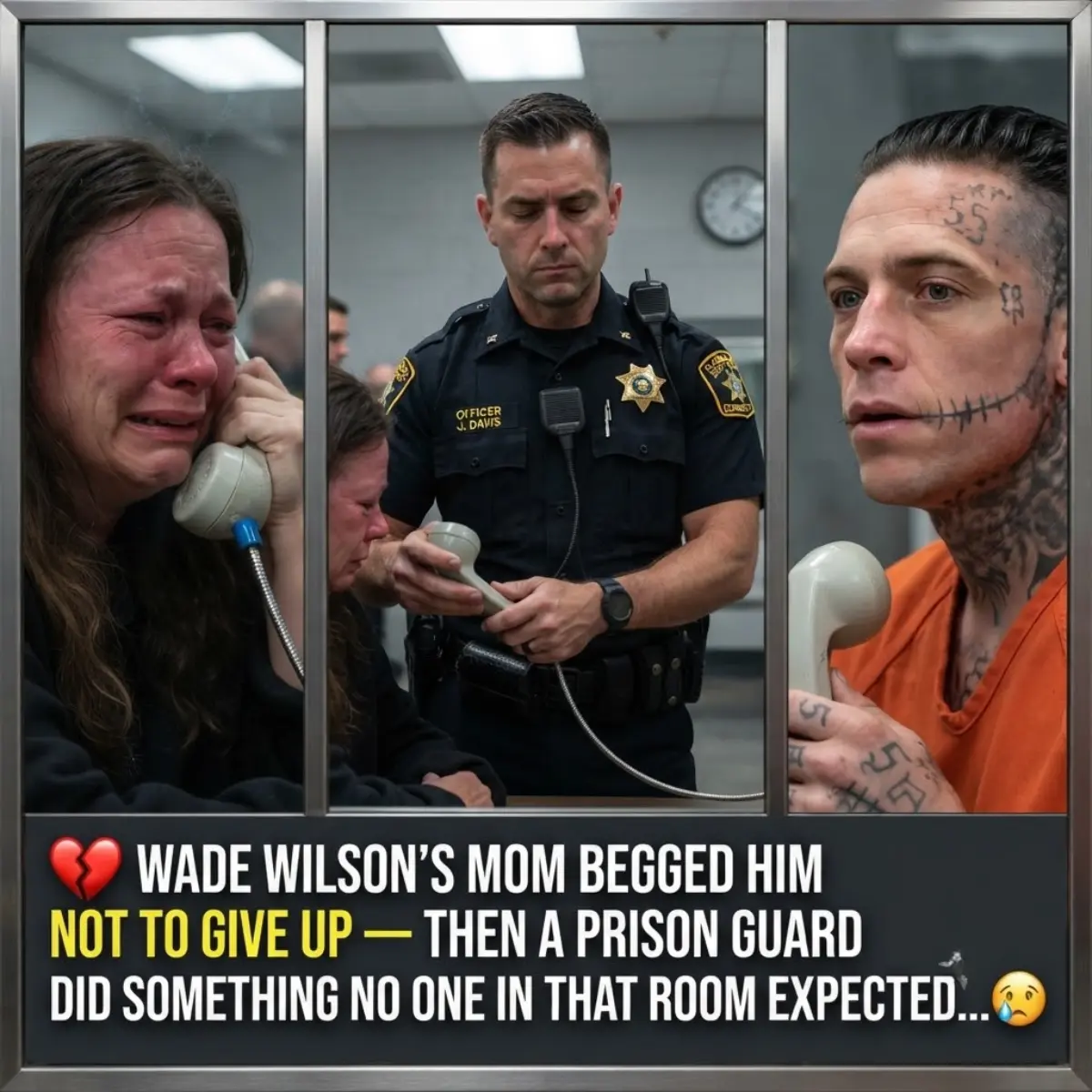
In the following fictionalized scene, a mother's plea and a correctional officer's quiet gesture become the center of an emotional moment.
But the larger story begins with two women whose lives were taken.
THE CRIMES THAT SHOCKED FLORIDA

Wade Wilson was convicted in connection with the 2019 murders of Kristine Melton and Diane Ruiz in Cape Coral, Florida.
The killings devastated two families and became the focus of a criminal prosecution that eventually resulted in a death sentence.
During the proceedings, jurors heard evidence concerning the circumstances of the murders and Wilson's actions.
The case received substantial attention because of the brutality of the crimes, Wilson's courtroom appearances, and the public reaction surrounding his conviction and sentencing.
Yet behind the headlines were two victims with their own relationships, memories, and futures.
Kristine Melton and Diane Ruiz were not simply names in a criminal case. They were individuals whose deaths left lasting grief among those who loved them.
Any discussion of Wilson's punishment or emotional circumstances must recognize that reality.
The suffering experienced by the victims' families remains central to understanding the human consequences of the case.
A MOTHER'S REAL PLEA FOR MERCY
One of the documented emotional moments in Wilson's case came from his adoptive parents, Cindy and Steve Wilson.
During sentencing, their letter to the court recalled the son they had known during childhood and described the deterioration they believed had followed his struggles with addiction and mental health.
They asked the judge to spare their son's life.
Their appeal was not enough to change the outcome. On August 27, 2024, Judge Nicholas Thompson imposed two death sentences, one for each murder.
That letter offers a factual foundation for understanding the anguish of parents whose child has committed devastating crimes.
It also raises an uncomfortable question: How does a parent reconcile memories of a beloved child with the reality of the terrible harm that child has caused?
For some families, love does not disappear after a conviction. But neither does that love erase responsibility.
THE UNEXPECTED GESTURE — A FICTIONALIZED SCENE
The following scene is imagined for dramatic storytelling. It is not a verified account of an actual prison visit.
The visiting room was almost silent.

A woman sat across from her imprisoned son, her hands trembling as she tried to find the words she had rehearsed countless times.
She had imagined this conversation during sleepless nights, hoping that somehow she could say something meaningful enough to reach him.
"Please don't give up," she whispered.
Her son lowered his eyes.
For several seconds, neither spoke.
The fluorescent lights hummed overhead. Somewhere beyond the door, footsteps echoed through the corridor.
The woman reached toward the barrier separating them.
"I know I cannot change what happened," she continued. "I know there are people whose pain will never disappear. But I still hope you can find a way to face what you've done."
Her voice broke.
A correctional officer standing nearby noticed that she was crying.
For a moment, he remained still.
Then he quietly stepped toward a nearby table, picked up a box of tissues, and placed it within her reach.
There was no speech, no dramatic declaration, and no attempt to interfere with prison procedures.
Just a small gesture of kindness.
The woman looked up, surprised.
"Thank you," she whispered.
The officer nodded and returned to his position.
In that imagined moment, the significance of the gesture was not that it changed the sentence or excused the crime.
It was simply a recognition that grief and human vulnerability can exist even in places defined by punishment.
COMPASSION DOES NOT MEAN FORGIVENESS
The fictional scene illustrates a distinction that is often lost in emotional discussions of criminal justice.
Showing basic compassion toward a prisoner or a prisoner's family does not require anyone to minimize the suffering of victims.
Correctional officers have demanding responsibilities involving security, safety, and the enforcement of institutional rules.
Within those responsibilities, ordinary acts of professionalism and humanity can still matter.
Offering someone a tissue, speaking respectfully, or allowing a moment of silence does not alter a conviction.
It does not overturn a sentence.
And it certainly does not erase the consequences of murder.
Instead, such actions can demonstrate that humane treatment and accountability are not necessarily opposing principles.
THE FAMILIES WHO CAN NEVER GET THEIR LOVED ONES BACK
For the relatives of Kristine Melton and Diane Ruiz, the central tragedy is not the uncertainty surrounding Wilson's future.
It is the permanent absence of two women who should have had many more years to live.
Their families have endured the criminal investigation, trial, sentencing, and continuing public attention surrounding the case.
The prosecution emphasized the importance of justice for the victims when the death sentences were announced.

This perspective deserves recognition whenever Wilson's story becomes the subject of emotional headlines.
While the experiences of his relatives may provoke sympathy, the consequences of his crimes remain devastating and irreversible.
The victims' lives must never become secondary to the notoriety of the man convicted of killing them.
WHAT HAPPENS NEXT FOR WADE WILSON?
Wilson's legal proceedings have continued beyond his original sentencing.
Public reporting in 2026 indicates that he remains under two death sentences, with legal challenges having reached the Florida Supreme Court. No confirmed
A death sentence does not automatically mean an execution is imminent. Capital cases involve additional judicial procedures, and any significant development must be established through official court records.
For Wilson's relatives, the uncertainty surrounding those proceedings may continue to carry an emotional burden.
For the victims' families, the same process may prolong the painful experience of revisiting the crimes and their consequences.
THE HUMANITY THAT REMAINS
The imagined moment between a grieving mother and a correctional officer cannot rewrite the events of October 7, 2019.
It cannot restore Kristine Melton or Diane Ruiz to their families.
It cannot resolve the moral and legal debates surrounding capital punishment.
But it can serve as a reminder that even within the harshest institutions, compassion may have a place.
A mother's love cannot undo her son's actions. A prison officer's kindness cannot erase a criminal sentence. And a moment of humanity cannot substitute for justice.
What it can do is remind us that accountability and human dignity must be considered together.
Ultimately, the Wade Wilson case is not simply a story about one condemned man or one family's sorrow.
It is a story about two lives violently taken, families permanently changed, and a justice system confronting some of society's most difficult questions.
And in the midst of those questions, one truth remains: the greatest tragedy belongs to the people who never had the chance to come home.